
THE ROY LAB


Welcome to the Roy Lab.
Uncovering the Molecular Basis of Legume Nitrogen Acquisition
Overview
Nitrogen (N) is arguably the most important nutrient for plant growth; addition of Nitrogen (N) based fertilizer maximizes crop productivity and was largely the reason many countries achieved food security during the green revolution. Nevertheless, the United Nations Environmental Program in their report "Frontiers 2018/19: Emerging Issues of Environmental Concern" declared Nitrogen overuse to be one of five emerging threats to the planet. N-fertilizers are produced by the Haber-Bosch process which require environmentally detrimental fossil fuels that are an added expense to farmers.
Our research seeks to find solutions that help mitigate problems of excess N-fertilizer use in agriculture while retaining all the benefits of Nitrogen availability for plant productivity. We use molecular genetics tools in the model legume Medicago truncatula to understand the process of biological Nitrogen Fixation wherein Legumes enter into relationships with symbiotic bacteria and 'fix' their own Nitrogen. We are interested in fundamental signaling pathways that underlie legume-microbe interactions and N-acquisition, particularly downstream of plant peptide hormones.
January 2026 - December 2026
2026
News
Timeline
Find Out What
We've Been
Upto in
18 / Hyndavi Presents at the Department Seminar
Oct 8, 2026: Hyndavi shares exciting new findings from her ongoing doctoral research titled "Unveiling the role of epigenetic regulation in the nitrogen-fixing symbiosis of Medicago truncatula" with faculty and students at TSU's department of Ag Sciences and Engg. seminar.

Hyndavi presenting her doctoral research at the departmental seminar.
17 / Welcome Ariel and Deshawn!
Sep 30, 2026: A warm welcome to sophomore Ariel and Deshawn, the newest members of the Roy Lab! Excited to have them join our research team.
16 / Welcome Odirichi!
Sep 24, 2026: We are delighted to welcome Ms. Odirichi Imoh to the Roy Lab! Having earned her Master's degree in Plant Breeding in Japan, Odirichi joins us as a temporary Graduate Research Assistant, excited to return to doing plant science research that she loves!
15 / Sonali Presents a Seminar at the University of Miami!
Sep 21, 2026: Sonali had the best time visiting colleagues at the University of Miami to share our lab's research on peptide signaling and legume–rhizobium symbiosis. Wonderful scientific discussions and an opportunity to connect with colleagues in plant symbiosis!
14 / Sonali Presents at the TSU Professional Academy.
Sep 18, 2026: Sonali shares her perspectives on designing effective scientific presentations at the TSU Professional Academy. A wonderful audience of exceptional undergraduate students and scholars from the TSU College of Agriculture!

Miracle Walker helping Sonali illustrate a key point about effective scientific presentations at the COA's Professional Academy!
13 / Sonali Visits the RIKEN Plant Science Center in Japan!
July 31, 2026: A lovely visit to RIKEN to catch up with longtime friend Akira Akamatsu, whom Sonali first met in Giles Oldroyd's lab. Akira is now a postdoc in Makoto Hayashi's lab and showed Sonali around RIKEN. Wonderful to reconnect after all these years!

Sonali and Akira in the Lotus japonicus greenhouse at RIKEN, home to another important model legume for studying root nodule symbiosis!
12 / Sonali Visits Munich, Germany!
July 22, 2026: A rewarding visit to Munich for scientific service and stimulating discussions with colleagues in the plant science community!
11 / Sonali and Kyla at ASPB Plant Biology 2026 in Ottawa, Canada!
July 17, 2026: Sonali joins Kyla at Plant Biology 2026 in Ottawa, Canada! Sonali attends the The Plant Cell Editorial Board meeting, presents a poster on teaching CRISPR, and enjoys reconnecting with colleagues from around the world for stimulating scientific discussions!
10 / New NSF CAREER Award Supports Our Research and Training Mission!
June 26, 2026: The Roy Lab has been awarded a prestigious NSF CAREER Award to investigate the host genetic mechanisms controlling legume promiscuity, with an emphasis on peptide hormones and leucine-rich repeat receptor kinases (LRR-RLKs).

Small but mighty like the molecular regulators we study - The present Roy lab members. L-R - Hyndavi, Rajni, Sally, Miracle, Sonali
9 / Introducing Our New RANGE Student!
June 14, 2026: We are pleased to welcome Sally Gandhi to the lab through the RANGE Program. Under the mentorship of incoming M.S. student Miracle Walker, Sally is learning the fundamentals of CRISPR and building foundational molecular biology skills.
8 / Shania Joins the Danforth REU Program!!
May 26 - July 31, 2026: Our undergraduate researcher Shania Dean-Motley is spending the summer at the Danforth Center through the REU Program, supported by our NSF HBCU-UP grant. She is conducting research in Dr. Tessa Burch-Smith's lab. Many thanks to Tessa for this wonderful opportunity.

Third from the left (front row) Shania Dean-Motley stands with her REU cohort members at the Danforth Center. PC: DDPSC
7 / Hyndavi and Rajni present their research at the 26th NASNFC in Kingston, Ontario!
June 2, 2026: Graduate student Hyndavi Yammanuru and postdoctoral scientist Rajni Parmar presented posters on their research, connected with colleagues in the rhizobium-legume community, and enjoyed many engaging scientific discussions. Sonali judged a poster session and chaired the Genetics of the Plant Host session.

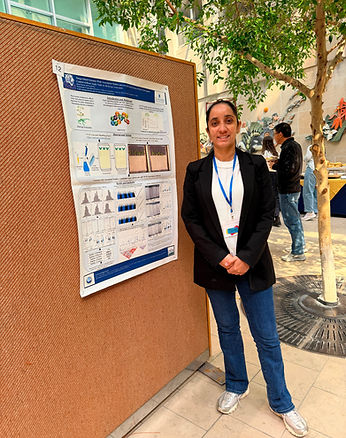
Left: Hyndavi and Right: Rajni present their posters at the Queen's University
6 / Wonderful presenting our research at the University of Washington at Seattle!
June 1, 2026: Sonali presented the lab's latest research during the Jill Fredericksen Endowed Lecture Series at the University of Washington, following an invitation from the graduate students. It was great meeting the students and faculty!
5 / Thank you to the College of Agriculture for recognizing Sonali with the Outstanding Teaching Award for 2026!
Apr 17, 2026: Sonali was awarded the 2026 Outstanding Teaching Faculty Award across five departments within the College of Agriculture. She was presented this certificate by the department Chair during her class "Gene Editing with CRISPR-Cas"

Sonali receives her certificate presented by Dr. Korsi Dumenyo
4 / Congratulations to graduate student Ms. Hyndavi Yammanuru for receiving the third prize in the university wide poster competition!
Apr 15, 2026: Hyndavi's poster titled "Do peptide hormones control the epigenetic regulation of legume nodulation?" won the third prize in the graduate student section.

Hyndavi (center) is awarded the third prize for her poster
3 / Congratulations to our collaborators Dr(s) Garcia-Fraile and Santa-maria and all co-authors on this wonderful review!
Feb 17, 2026: The review discusses how evolution shapes plant-associated bacteria and influences whether they become beneficial partners or pathogens. We are grateful to have been a part of this effort!. Read the paper here.

Figure showing overview of different plant-associated microbial lifestyles
2 / Sonali is appointed as an Associate Editor for the Molecular Plant Microbe Interactions journal of the IS-MPMI.
Jan, 2026: We are pleased to serve one of our favorite scientific societies, IS-MPMI, as an Associate Editor! In this role, we will help evaluate manuscripts in peptide signaling and legume–beneficial symbioses, supporting the advancement of plant and microbial science.
1 / Congratulations to Kyla Hughes on her ASPB Recognition Travel Award for Plant Biology 2026!
Jan 11, 2026: We are proud to congratulate Kyla Hughes, a senior undergraduate researcher in our lab, on receiving a Recognition Travel Award from the American Society of Plant Biologists. The award supports her attendance at Plant Biology 2026 in Ottawa, Canada.

Kyla Hughes showcasing her research on Medicago truncatula in our lab.
January 2025 - December 2025
January 2024 - December 2024
January 2023 - December 2023
January 2022 - December 2022
January 2021 - December 2021
CONTACT US
Tennessee State University
College of Agriculture
3500 John A Merritt Blvd
Nashville, Tennessee, 37209
Office: +1-(615)-963-1899